Understanding Audiometry Tests: Purpose, Types, Procedure, and Results
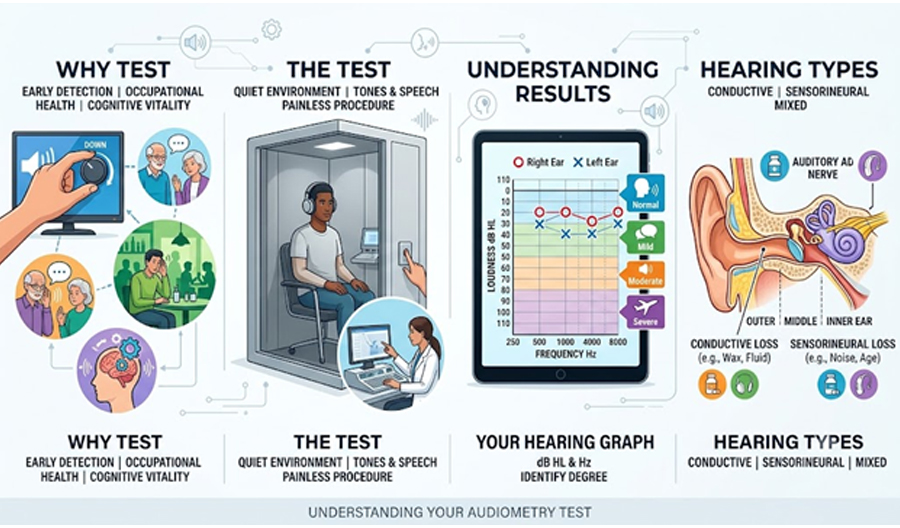
Have you noticed yourself turning up the TV volume higher than usual? Or finding it difficult to follow conversations in noisy places? It could well be a sign of hearing loss slowly creeping into your ears. Hearing loss is often overlooked, as it happens so gradually that you might not notice it at first; but when you do, it may already be late. To be sure whether any hearing loss is happening, it is best to get an audiometry test done on one or both ears. An Audiometry Test is a safe, painless diagnostic procedure used to evaluate how well you hear. It measures both the pitch (frequency) and loudness (intensity) of sounds your ears can detect.
1. Why Is an Audiometry Test Done?
An audiometry test does much more than determine whether you can hear properly; it serves as a critical diagnostic tool for long-term health and lifestyle management.
- Early Detection of Noise-Induced & Age-Related Hearing Loss: Hearing loss often develops gradually over several years (age-related loss is also called presbycusis). Early testing captures minor declines before they begin isolating you from social interactions or work environments.
- Pinpointing Medical & Structural Issues: It helps determine whether hearing difficulty stems from a simple physical obstruction (like compacted earwax or fluid buildup) or permanent neural damage within the inner ear.
- Evaluating Workplace & Environmental Exposure: For individuals working in high-noise industries (factories, aviation, construction, music production), regular baseline audiometry tests monitor hearing safety and help prevent irreversible occupational hearing damage.
- Preventing Cognitive Decline: Scientific research links untreated hearing loss to higher cognitive strain, memory issues, and an increased risk of dementia in older adults. Identifying hearing loss early helps keep the brain active.
- Precision Prescription for Hearing Devices: If you require hearing aids or assistive devices, an audiogram acts like an optical prescription, allowing the audiologist to program the device precisely to boost only the specific frequencies you lack.
2. Common Types of Audiometry Tests
Depending on the symptoms you are experiencing and your age group, audiologists conduct different variations of audiometry tests:
| Test Type | What It Evaluates | Primary Use |
|---|---|---|
| Pure Tone Audiometry (PTA) | Measures the softest tones you can hear at different pitches via headphones (air) and behind the ear (bone). | Most common routine test for adults & older children. |
| Speech Audiometry | Measures how well you detect/understand spoken words at different volumes. | Assesses real-world speech perception. |
| Tympanometry | Evaluates eardrum movement and middle ear pressure. | Detects fluid, wax, or middle ear infections. |
| Otoacoustic Emissions (OAE) | Checks inner ear (cochlea) responses without requiring verbal participation. | Infant screening & young children. |
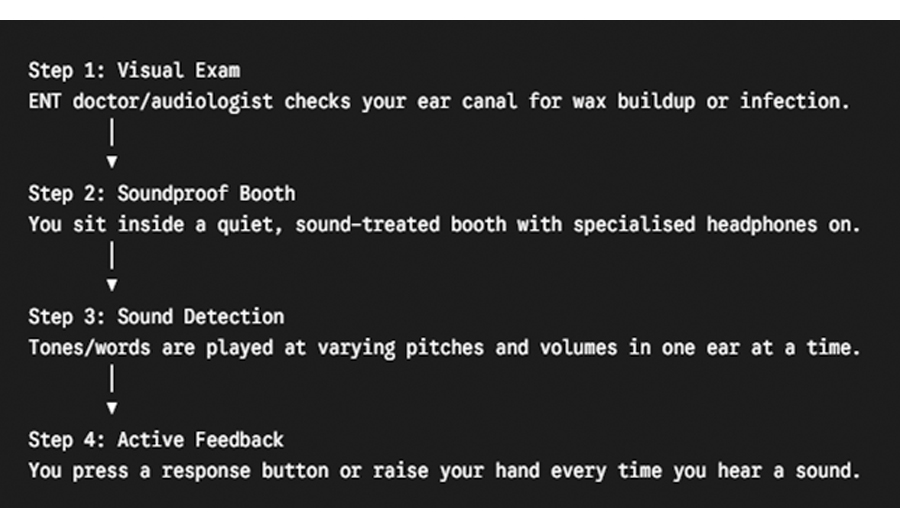
3. How Is the Test Performed?
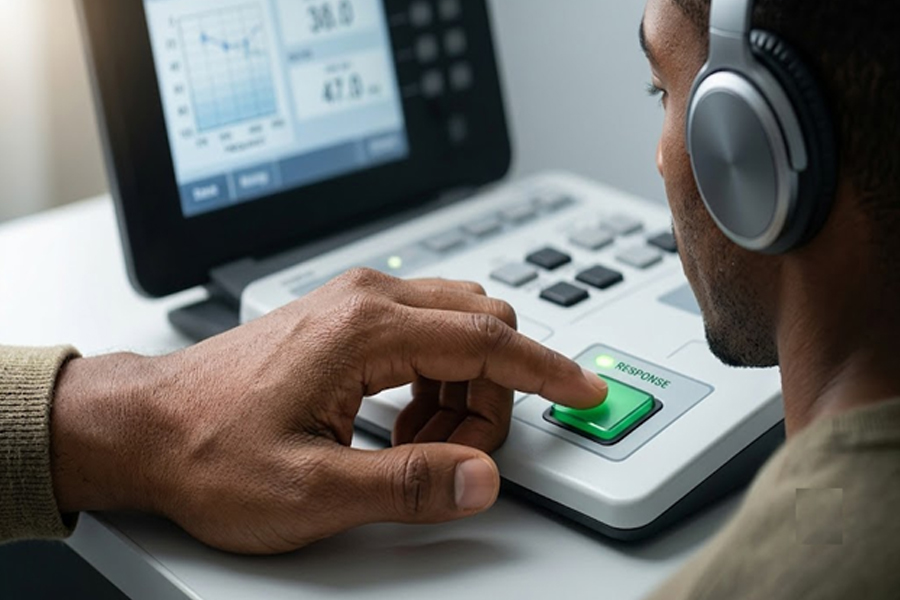
The procedure is simple, non-invasive, and typically takes 20 to 40 minutes.
4. Understanding Your Results (The Audiogram)
An audiogram is a chart created to record how well someone can hear different types and tones of sounds. It maps the quietest tones a person can detect across a range of pitches, also called frequencies. The higher the marks appear on the graph, the softer the sound that was heard. When plotted, the results reveal whether hearing is within normal limits or shows signs of loss, and to what degree. After completing the test, your audiologist generates a graph called an Audiogram.
How to Read an Audiogram
- Vertical Axis (Y-axis): Measures Loudness / Intensity in decibels Hearing Level (dB HL), ranging from very soft (0 dB) at the top to very loud (120 dB) at the bottom.
- Horizontal Axis (X-axis): Measures Pitch / Frequency in Hertz (Hz), ranging from low frequencies (250 Hz, like a bass drum) on the left to high frequencies (8000 Hz, like a bird chirping) on the right.
- Ear Symbols: Typically, the Right Ear is marked with red circles (O), and the Left Ear is marked with blue crosses (X).
Decibel Ranges & Degree of Hearing Loss
| Level (dB HL) | Severity | What It Feels Like in Daily Life |
|---|---|---|
| -10 to 25 dB | Normal Hearing | You comfortably hear whispers, rustling leaves, and quiet conversations. |
| 26 to 40 dB | Mild Hearing Loss | Soft speech or background noises (e.g., ticking clocks, birds) are missed. Following conversations in busy restaurants gets tiring. |
| 41 to 55 dB | Moderate Hearing Loss | Understanding normal spoken speech without a hearing aid becomes difficult. TV volume needs to be significantly raised. |
| 56 to 70 dB | Moderately Severe | You struggle to hear speech at normal conversational levels; shouting or loud speech is required. |
| 71 to 90 dB | Severe Hearing Loss | You cannot hear everyday speech or traffic sounds. Group conversations are almost impossible without assistance. |
| 91+ dB | Profound Hearing Loss | Extremely loud sounds (like jet engines or construction equipment) are barely audible. Communication relies heavily on visual cues or sign language. |
5. Types of Hearing Loss Identified
An audiometry test differentiates between two main pathways of hearing: Air Conduction (sound passing through the ear canal and eardrum) and Bone Conduction (sound vibration sent directly to the inner ear via the skull bone). This comparison reveals three distinct types of hearing loss:
a. Conductive Hearing Loss
- Where it occurs: Outer or middle ear.
- What causes it: Physical obstacles preventing sound from reaching the inner ear, such as impacted earwax, middle ear fluid (otitis media), a perforated eardrum, benign tumors, or bone abnormalities (otosclerosis).
- Is it reversible? Yes, in most cases. Conductive hearing loss can frequently be treated or cured with medical ear cleaning, antibiotics, or minor surgical procedures.
b. Sensorineural Hearing Loss (SNHL)
- Where it occurs: Inner ear (cochlea) or the auditory nerve connecting the ear to the brain.
- What causes it: Damage to tiny hair cells inside the cochlea due to natural aging, prolonged exposure to loud music/machinery, genetic factors, head trauma, or certain ototoxic medications.
- Is it reversible? Generally, no. SNHL is typically permanent because inner ear hair cells do not regenerate. However, it can be effectively managed with modern digital hearing aids or cochlear implants.
c. Mixed Hearing Loss
- Where it occurs: A combination of both outer/middle ear and inner ear issues.
- Example: An individual with age-related inner ear hearing loss (sensorineural) who also develops a middle ear infection or wax blockage (conductive).
- Treatment: Medical treatment is used to resolve the conductive component first, followed by hearing aids to manage the remaining loss.
Key Takeaways
The audiometry test is painless, safe, and quick; it involves no needles, radiation, or discomfort, taking under 40 minutes for a complete audit of your hearing health. This test is crucial for all ages; whether a newborn (OAE screening) or an adult, routine audiometry tests help ensure speech development and social connections remain intact. Book an audiometry evaluation at your nearest hearing aid clinic like Audizone Hearing if you experience persistent ringing in the ears (tinnitus), frequently ask people to repeat themselves, feel ear fullness, or struggle to hear in crowded environments. You can get tested by certified audiologists at diagnostic centers, dedicated hearing aid clinics like Audizone, or through an ENT specialist if you suspect an infection or physical injury.
AudiZone Speech & Hearing Clinic in India operates through its 16 branches across 3 states of Odisha, Jharkhand and Chhattisgarh in cities like Bhubaneswar, Cuttack, Brahmapur, Balasore, Koraput, Rourkela, Sambalpur, Keonjhar, Jamshedpur, Durg, Bilaspur, and Raipur. Audizone has a team of over 100 highly qualified audiologists who have so far successfully treated over 1 lakh patients, including kids and adults, for hearing and speech related issues. AudiZone provides various types of branded hearing aids such as Signia, Phonak, Widex, ReSound, Starkey, and Oticon to patients based on their preference and requirement.